The United States has the most complete and complex tax system in the world. Be it an individual, an entrepreneur, or an investor, a basic understanding of federal and state income taxes, deductions, and credits is crucial when doing proper tax planning. Given all the changes and inflation adjustments, knowing your way around will be more important than ever for the 2025-26 tax year. Our suite of USA Tax Calculators walks one through federal income tax, payroll, capital gains, property taxes, sales tax, social security contributions, and state-specific requirements.

Federal Income Tax: How It Works 2025-26
The progressive U.S. federal income tax is a tax bracket system in which levies are higher with higher income levels. Brackets have been adjusted for the 2025-26 tax year by the Internal Revenue Service to account for inflation. This keeps people from drifting into higher brackets simply because of cost-of-living increases.
You need to know the brackets, considering your filing status: single, married filing jointly, married filing separately, or head of household. It will keep you ahead and help with proper tax planning.
Key Components
| Components | Description |
|---|---|
| Income | Total of all income from every source that is subject to taxation |
| Filing Status | Single, Married Filing Jointly, Head of Household, etc. |
| Tax Brackets | Progressive rates imposed on income |
| Deductions | Standard vs. Itemized |
| Credits | Directly reduce taxes owed |
Payroll Taxes and Take-Home Pay
Payroll taxes, particularly those that fund Social Security and Medicare, play a significant role in the US tax system. It is normally referred to as FICA taxes, shared between the employee and the employer.
- Social Security tax: 6.2% each for the employee and employer, both applied to wages up to the annual limit.
- Medicare tax: 1.45% of all wages; an additional 0.9% on wages in excess of a threshold amount for high-income workers.
You can approximate your take-home pay with deductions using a payroll calculator, which in turn makes budgeting or finance planning so much easier.
Long-term versus Short-term Capital Gains
Understanding the concept of capital gains tax is very important for any investor or seller of any property.
- Short-term gains represent any assets held for one year or less. Their sale is taxed as ordinary income.
- Long-term gains are such assets that are held for more than a year; then the rate of taxation becomes 0%, 15%, and 20%, depending upon income.
Knowing the difference in taxation between short- and long-term gains will help you further fine-tune your investment strategy by aiming to minimize your total tax liability.
State and Local Taxes
In addition to federal taxes, state and local taxes offer another layer of complexity: some states—like Florida, Texas, and Nevada—do not have state income taxes, while other states—like California and New York—have progressive income taxes in excess of 10%.
- Property Taxes: These vary by locality and are based on real estate.
- Sales taxes: These are imposed by states and localities and range from 0% to more than 10%.
Understanding these taxes is crucial for individuals living or investing in different states.
US Tax Calculator Tools & Features
US tax calculators are useful for employees, freelancers, and businesses.

- 🔹 Federal Income Tax Calculator
- 🔹 Payroll (FICA) Tax Calculator
- 🔹 Sales Tax Calculator
- 🔹 Property Tax (State or Country) Calculator
- 🔹 Capital Gains Tax Calculator
- 🔹 Social Security and Medicare Tax Calculator
- 🔹 401k contributions and tax savings Tax Calculator
- 🔹 State Income Tax Calculator
Deductions and Tax Credits
Generally speaking, your tax liability boils down to two things: deductions and credits.
- Standard Deduction: For 2025-26, the standard deduction was increased for inflation.
- Itemized deductions: You will love these if you pay a lot in mortgage interest, state and local taxes over $10,000, charitable donations, or medical expenses.
- Tax credits: Dollar-for-Dollar reductions of tax liability. Examples include the Child Tax Credit, Earned Income Tax Credit, and credits for education.
Retirement Accounts and Related Tax Benefits
Contributions to retirement accounts have numerous significant tax advantages:
- Traditional 401(k) and IRA: You can deduct the contributions, thereby lowering your current taxable income.
- Roth accounts: These are funded with after-tax dollars but withdrawn in retirement tax-free.
Contribution limits are indexed for 2025-26. Use our calculators to model different scenarios and help maximize your retirement savings while minimizing your taxes.
Why Using Calculators for US Taxes is a game-changer
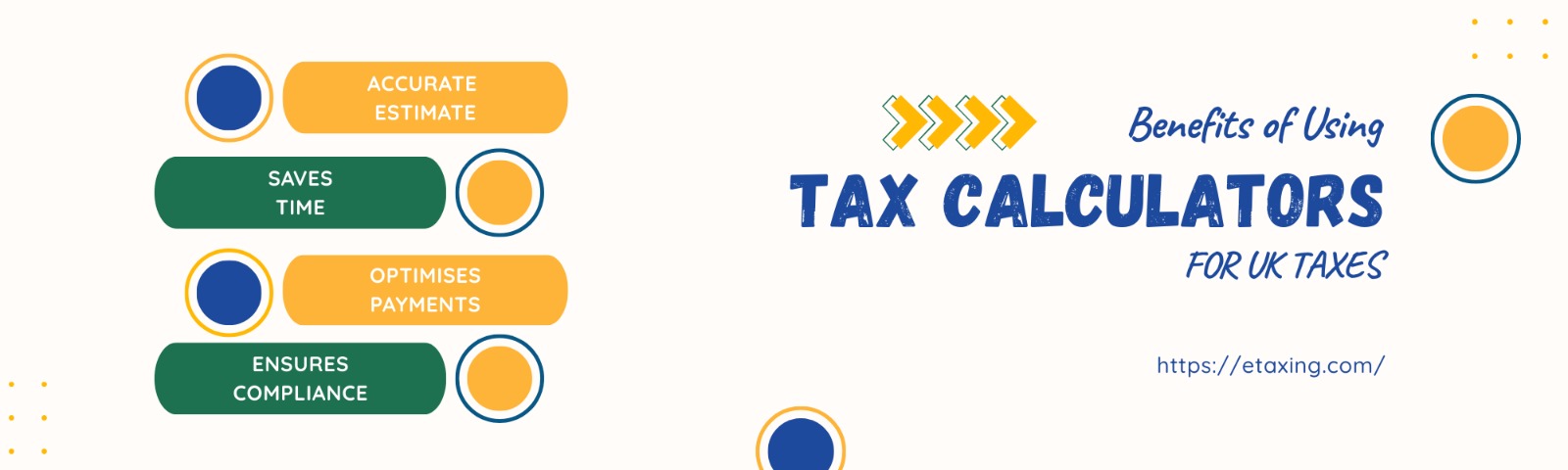
- You can get a pretty good estimate of what your tax bill is going to be.
- It saves you from having to do all the math yourself - a big time-saver.
- With a good calculator, you can actually make a real plan for your finances - not just guesswork.
- Helps you make the most of your deductions and credits - not to mention other benefits you might be eligible for.
- Covers a whole bunch of different income streams - not just one boring old job.
- Ensures you're following the IRS rules - no nasty surprises at tax time.
- Let's you play around with different scenarios - like "what if I get a promotion?" and see how it changes things.
- Reduces that general feeling of dread that comes with tax season.
How U.S. Federal Tax Is Calculated—Formula
It is the same principle used by IRS forms and tax calculators.
Summary Formula
Less – Adjustments
= AGI
Less – Standard or Itemized Deductions
= Taxable Income
× IRS 2025 Tax Brackets
= Tentative Taxes
+ Other Taxes
– Credit
– E-payments/W-2 Withholding
= Final Tax Due or Refund
FAQs on the USA Tax System
Q: Do I have to file taxes if I didn't make that much money?
A: You must file if you made more than the standard deduction amount. For 2025-26, that's $13,850 for single people and $27,700 for married couples.
Q: Can I file taxes for free?
A: Yes! If you make less than $73,000, you can utilize IRS Free File. There are also free preparation sites called VITA locations.
Q: What documents are necessary to file my taxes?
A: You will need your W-2 from work, 1099 forms if you have other income, receipts for deductions, and your Social Security card.
Q: Should I take the standard deduction or itemize?
A: Take whichever is higher. Most people take the standard deduction because it is easier and often more money.
Q: What if I made a mistake on my tax return?
A: You would file an amended return using Form 1040-X. You may file a claim for a refund within a three-year time period.
Q: Do I pay taxes on unemployment benefits?
A: Yes, unemployment money is considered income, and you pay taxes on it.
Q: How is a deduction different from a credit?
A: A deduction lowers the income on which you pay taxes. A credit directly cuts the tax you owe dollar for dollar.
Q: Can I deduct my home office?
A: Yes, if you use part of your home only for work. You can deduct $5 per square foot up to 300 square feet.
Q: What if I didn't get my W-2?
A: Ask your employer first. If they won't give it to you, call the IRS at 800-829-1040. You may also file using Form 4852.
Q: Must I declare cash as income?
A: Yes, even if it is cash and you did not get a tax form for it, all income must be reported.
Q: When will I get my tax refund?
A: Generally, within 21 days if you file electronically. Paper returns take 6-8 weeks
Final Conclusion
Understanding the fundamental components of the system, such as tax brackets, state tax, payroll tax, tax credits, and retirement contribution plans, makes the U.S. tax system far less confusing. The information for 2025-2026 will enable more accurate tax-saving strategies.
All year round, U.S. tax calculators allow you to estimate your tax liability and make better financial decisions.
Still not sure about your tax situation? Get expert assistance today! Call us or use our USA Tax Calculators to calculate your taxes instantly. A little clarity today can save you a lot later.